3.5kW to 22kW: One Portable Type 2 Charger That Switches Power for Every Aussie Charging Scenario
MotiveX's Smart Portable EV Charger can be changed and swapped between several power levels — from a household 3.5kW top-up to a 3-phase 22kW session — on the same compact, take-anywhere unit.
Actual delivered power still depends on your vehicle's onboard charger, the outlet, the circuit rating and the adapter fitted. Always match the plug, the vehicle and the current setting to a permitted, compatible connection to get the maximum power the tier can offer.
View the Smart Portable Charging StationModel ST-E209 · IP65 · Mechanical life >10,000 plug cycles · 2-Year Warranty
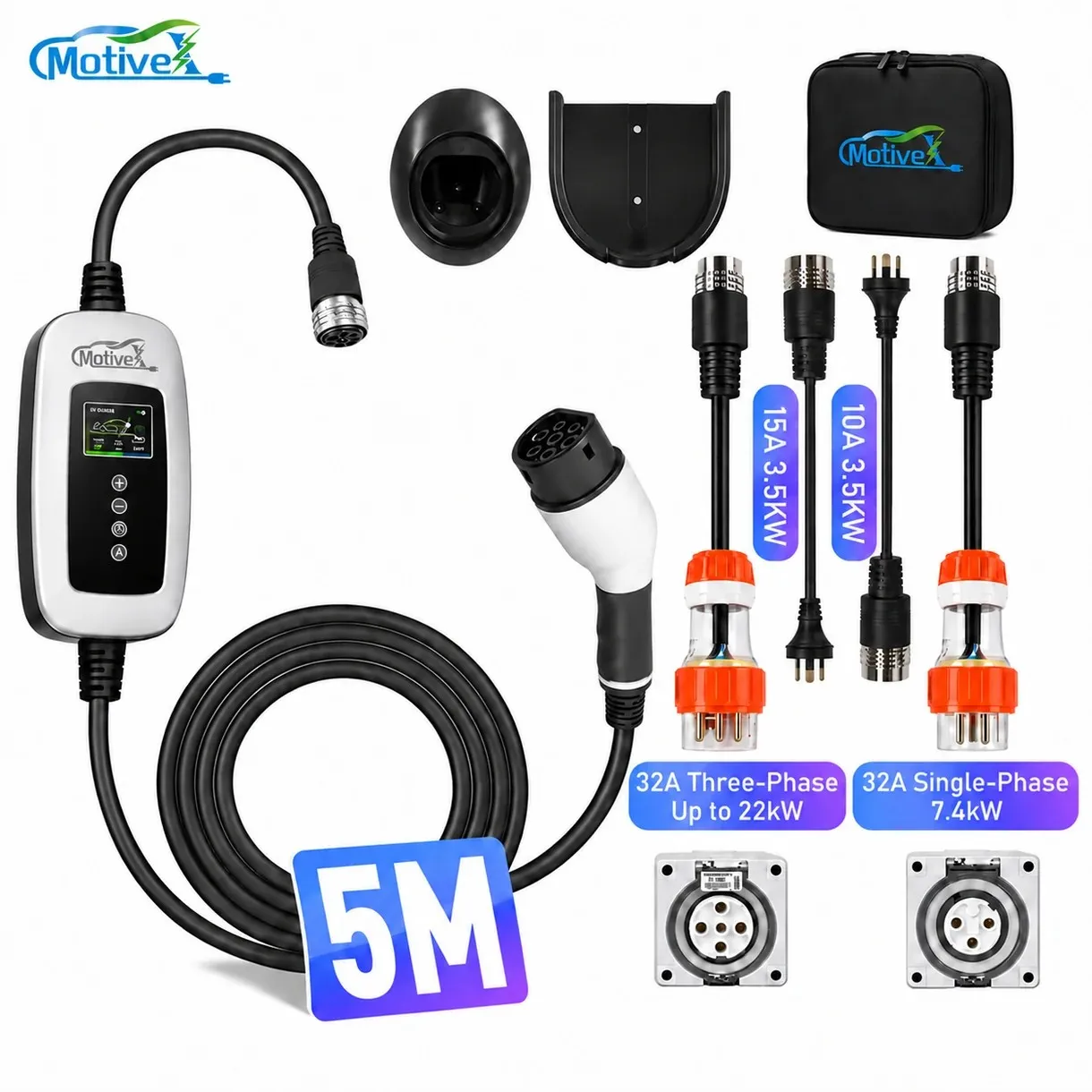
Change the plug. Change the power. Same unit.
This charger can be changed and replaced between several power levels — from 3.5kW household charging up to 22kW — on the same compact body. It's genuinely portable and easy to keep at home, so you can try a different plug and power tier whenever your outlet or trip calls for it. Note that the plug, the vehicle and the available current must all match the outlet you're using for the charger to reach that tier's maximum power.
15A / 10A AU household plug. Suited to a standard overnight top-up.
32A single-phase CEE plug. A quicker option where that circuit is available.
32A three-phase CEE plug, for properties wired for three-phase supply.
Built to move with your week, not just your driveway.
Switching power tiers only matters if it maps to how you actually charge. The same compact 5M-cable unit travels between the places most Australian EV owners actually plug in — swap the adapter and settle into whichever tier that outlet supports.
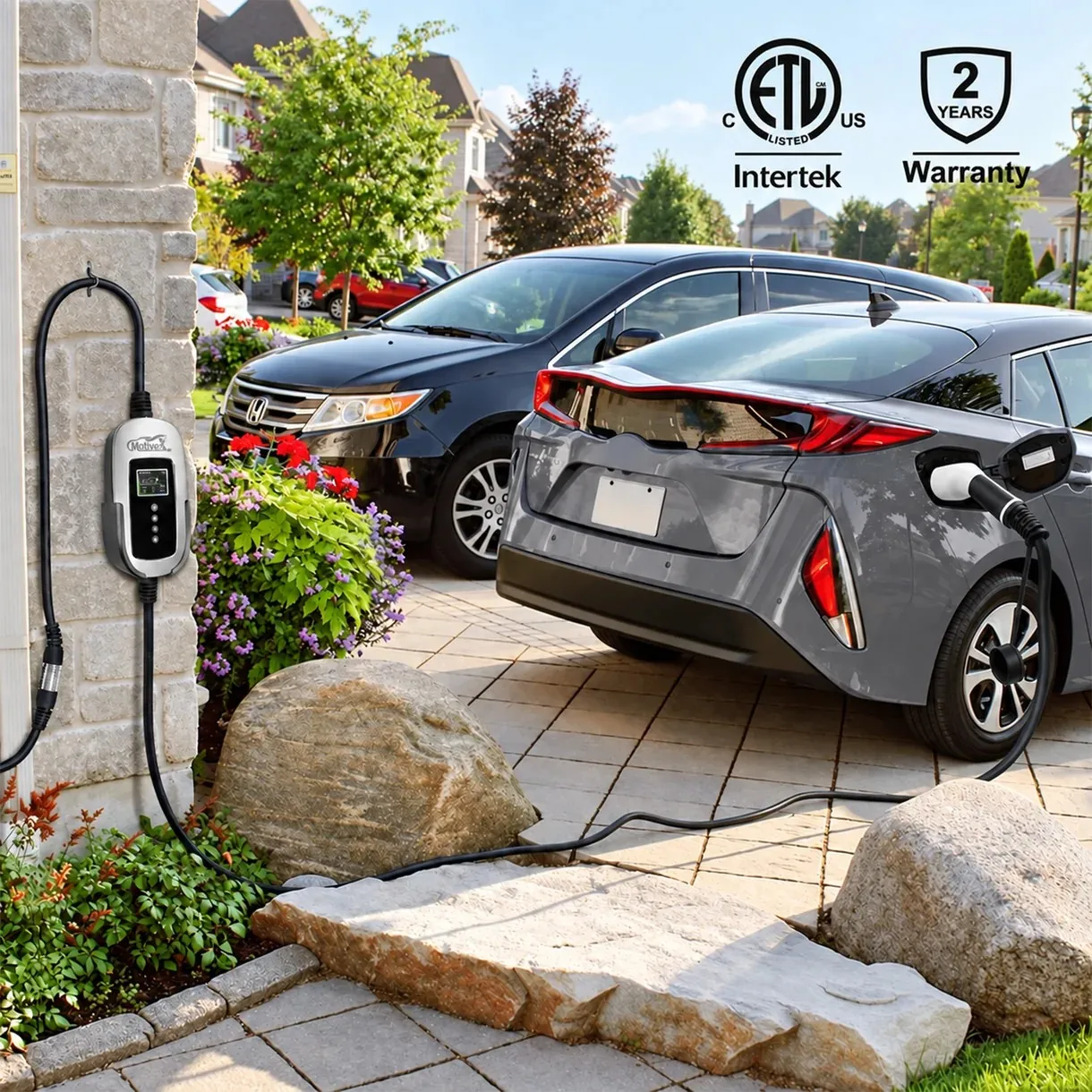
Hung on a hook by the front path, cable clear of the walkway — a steady 3.5kW overnight top-up.
Calm, unattended overnight charging
Keep the unit hung near the entry, route the cable clear of foot traffic and garden beds, plug into the household outlet on the 3.5kW tier, and check the LCD before you head inside.
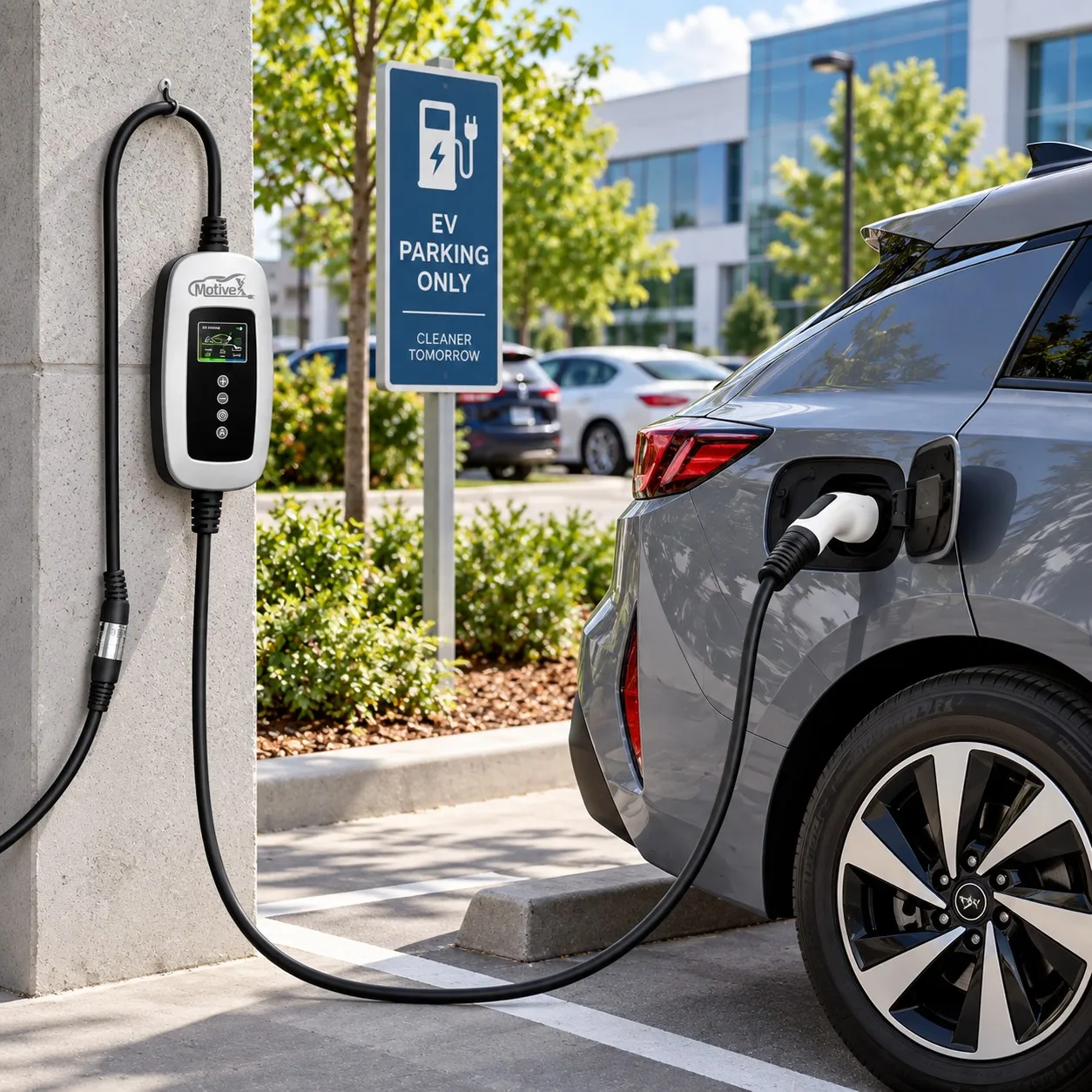
A designated EV parking bay at the office — switch to the 32A single-phase plug for up to 7.4kW.
Faster top-ups when time is tight
Where a workplace or building has a designated EV bay with a 32A single-phase CEE outlet, fit the matching adapter and step up to the 7.4kW tier — roughly double the household rate, so a workday parked in the bay can add meaningfully more range than an overnight-only unit could manage in the same hours.
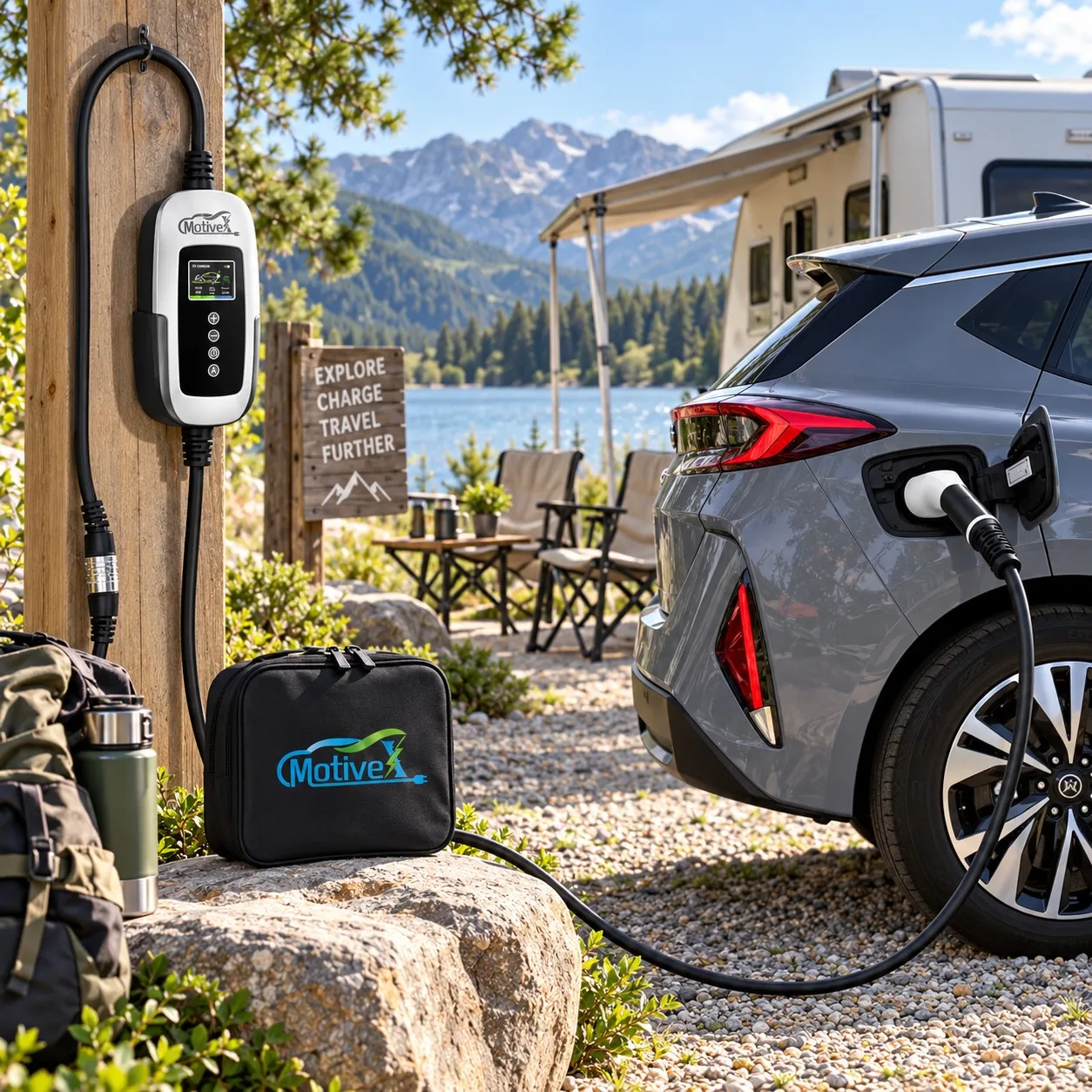
Hung on a post at a lakeside campsite, carrying case within reach — charge alongside the trip, not in place of it.
Charge on the go without losing the day
Confirm the site's rules and outlet rating with the operator first, then hang the unit on a post or rail and connect. The carrying case keeps the full adapter set together, so topping up beside the caravan doesn't cost you a special trip or slow down the itinerary.
Six steps, straight from the manual.
MotiveX's user manual lays out a simple sequence for every session — the same steps apply whichever power tier you're on.
Check the cable
Inspect the power distribution cable for damage before powering up.
Plug in the mains
Insert the mains plug into a socket that matches national standards.
Confirm the socket
Make sure the outlet corresponds to the plug fitted.
Connect the vehicle
Insert the vehicle connector fully until it clicks into place.
Let it auto-run
The charger works automatically; the indicator blinks blue during charging.
Adjust if needed
On current-adjustable models, switch power and current before connecting to the vehicle.

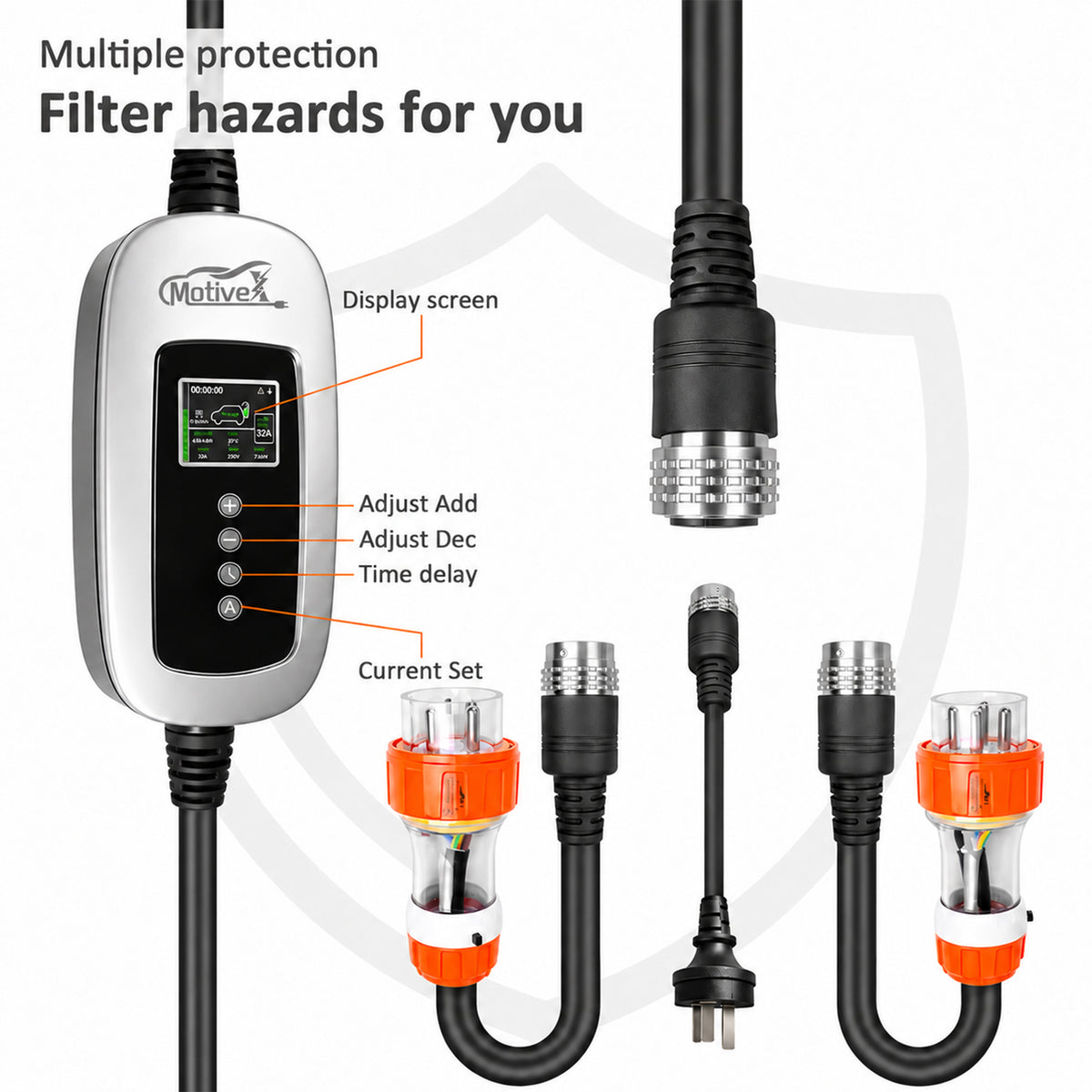
Set the start. Let the display track it.
The interface display supports delayed charging: click once to add an hour, up to a maximum setting of 12 hours. Set it before you connect, then confirm the countdown before you walk away — useful for overnight windows or off-peak periods.
- Delay is added in 1-hour steps, up to 12 hours maximum.
- The current can also be adjusted on-screen across 6A–48A steps.
- Recheck the display once the delay is set to confirm it will start as expected.
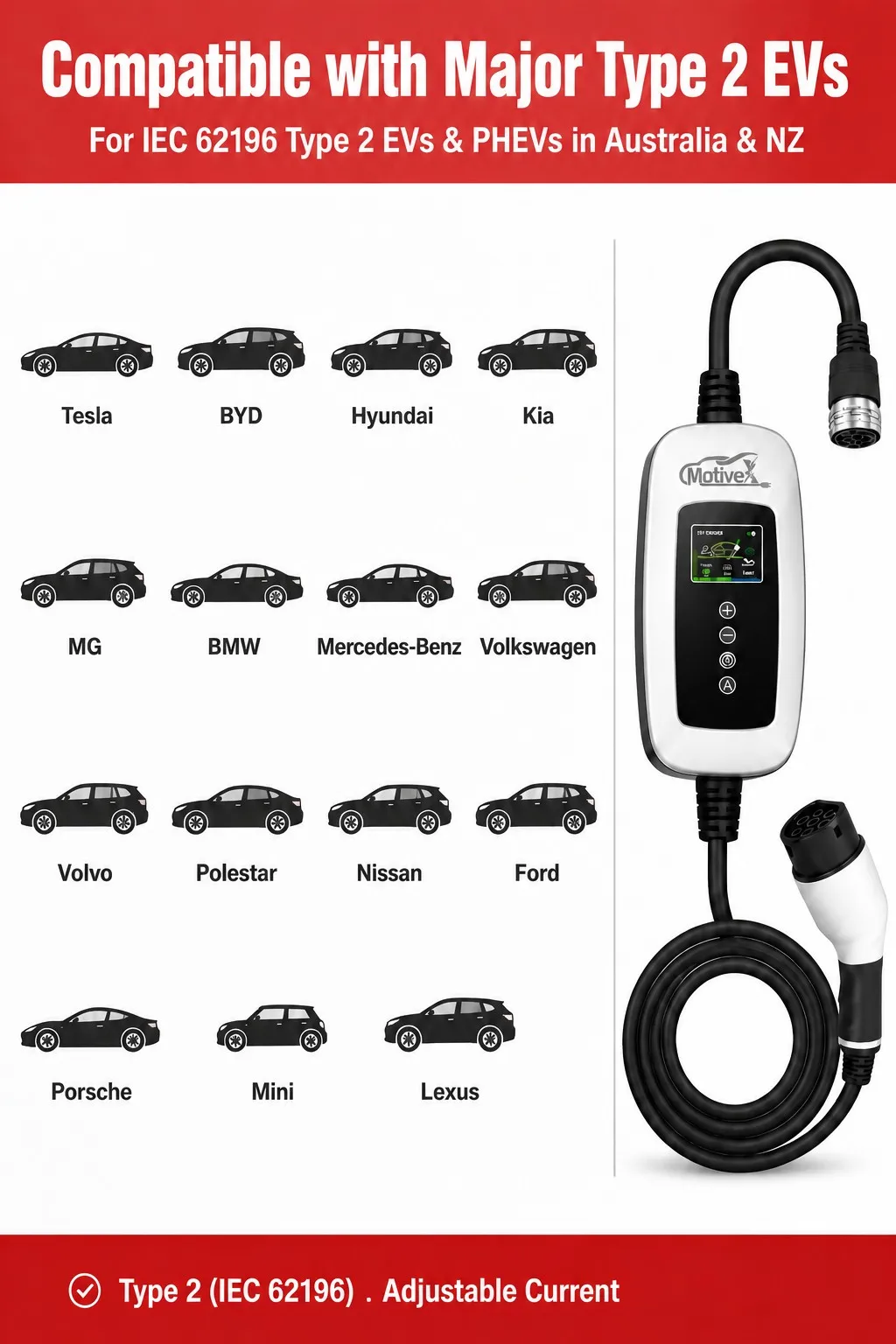
Compatible with major Type 2 EVs sold in AU & NZ.
The MotiveX charger uses the IEC 62196 Type 2 connector standard across every power tier, so the same plug head fits the inlet on most electric and plug-in hybrid vehicles currently sold locally — only the current setting changes.
- Confirm your vehicle's onboard charger rating before selecting a power tier.
- Type 2 fits the majority of AU/NZ-delivered EVs and PHEVs; always check your owner's manual for edge cases.
- Keep the carrying case and full adapter set together so the right plug is on hand for the right outlet.
Protection and durability, straight from the spec sheet.
Every power tier runs through the same protection logic documented in the manual, backed by an IP65-rated enclosure rated for real outdoor handling.
- Leakage protection — restarts and recovers automatically after a detected leakage event.
- Over/under-voltage protection — self-checks and recovers from abnormal grid conditions.
- Lightning, over-current and overheat protection — active across the full working range.
- Mechanical life — rated for over 10,000 no-load plug-in/pull-out cycles.
- Impact resistance — tested to withstand a 1m drop and a 2-tonne vehicle roll-over on the cable.
Read the indicator light before you walk away.
The manual defines a clear light language so you can confirm status at a glance without opening the app.
| Light | State | Meaning |
|---|---|---|
| Green | Stays on | Power on, unplugged — ready to connect. |
| Blue | Stays on | Plug inserted, not yet charging. |
| Blue | Flashing | Charging mode active. |
| Blue | Stays on | Charging completed. |
| Red | Flashing (count-coded) | Fault present — CP voltage, grid voltage/frequency, grounding, over-current, leakage or over-temperature. Each fault has a distinct flash count per the manual. |
Remark: each red-light error pattern flashes at 0.5s intervals with a 2s pause, repeating in a continuous loop until resolved.
Who gets the most from a switchable-power charger?
Home owners
Start on the standard plug now, step up to 32A later without buying a second unit.
Tradies & small fleets
Carry one charger between job sites with different outlet types.
Caravan & camp owners
Fit the three-phase adapter where the site's pedestal and rules allow it.
Multi-EV households
Move the same charger between two vehicles and two outlet types.
Renters & shared parking
A portable kit you can switch between whatever compatible outlet is available.
Verify the specification, not the marketing.
Confirm the exact SKU's power tiers, adapters and delay-charging steps in the current manual.
Check the IEC 62196 Type 2 connector against your vehicle's charging inlet.
Review the 2-year warranty terms and MotiveX support channel for your order region.
Keep the manual, order record and full adapter set together in the carrying case.
Questions before you switch plugs.
Tap a question to expand it.
Yes. The unit is designed to be changed and swapped between power levels — 3.5kW, 7.4kW and up to 22kW — by fitting the matching adapter. It stays portable and easy to keep at home, so you can try a different tier whenever your outlet or trip calls for it. The plug, the vehicle and the available current all need to match the outlet for that tier's maximum power to apply.
The 15A/10A AU household plug is rated for 3.5kW, the 32A single-phase CEE plug for 7.4kW, and the 32A three-phase CEE plug for up to 22kW. Actual delivery still depends on your vehicle, outlet and circuit.
You need a compatible, permitted outlet already installed and rated for the current you select. Have an electrician confirm circuit capacity before using 32A single- or three-phase settings.
Yes. The display supports delay charging in 1-hour increments up to a 12-hour maximum — set it before connecting and confirm the countdown is running.
Ask the site operator first and confirm the outlet's rating and phase before fitting the matching adapter. The carrying case keeps the full adapter set together so a top-up beside the caravan doesn't slow down the itinerary.
The charger uses the IEC 62196 Type 2 connector, which fits most EVs and PHEVs sold in Australia and NZ. Confirm your specific model's inlet in your owner's manual.
Green stays on when powered but unplugged; blue stays on when connected and flashes while charging; red flashes in a specific count pattern to signal faults such as grounding, over-current or leakage — see the table above.
The manual rates the control box for over 10,000 no-load plug/pull cycles and a 1m drop plus a 2-tonne vehicle roll-over test on the cable, with an IP65-rated enclosure.
Five real-world charging conversations.
Caravan 32A plugs — which EV charger?
Is an 11kW charger at home worth it?
Type 2 charging cable — any cheap one will do?
Best 32 amp charger option??
Fastest home charger for a 3-phase-powered house?
Always confirm compatibility, current product documentation, outlet permission and local electrical requirements before charging.